 Simon van der Schans
Sharing Insights at ISPOR Europe 2025: Our Poster Highlights
 Florian Zeevat : 6 November 2025, 13:33:44 CET
Join Health-Ecore at ISPOR Europe 2025 in Glasgow to explore HEOR research on prevention, obesity, Alzheimer’s, and informal care.

A new study shows that a machine-learning model can predict how Dutch medicine prices change before and after loss of exclusivity for most products. This gives cost-effectiveness and budget impact analyses a more realistic basis than the static prices they use today.
Cost-effectiveness and budget impact analyses that inform reimbursement decisions usually assume a medicine’s price stays the same over the whole time horizon. In practice, prices rarely stay fixed. They move with competition, reference pricing, preference policies and confidential negotiations. The sharpest change comes when generics or biosimilars enter after a product loses exclusivity (LoE). Earlier research found that Dutch list prices fell by 41% on average in the first four years after LoE, and fell more steeply for higher-revenue medicines (1).
This affects the decision itself. In four case studies, replacing static prices with dynamic prices lowered the ICER by up to 43% in a single-cohort analysis and by up to 113% in a multicohort analysis. In one case, the ICER moved from €9,241 per QALY to cost-saving (2). Evaluations whose time horizon runs past the exclusivity period are the most affected.
The new publication (3) describes and internally validates a method for forecasting these price trajectories. The team used monthly Farminform sales data from 2000 onwards to calculate inflation-adjusted prices per defined daily dose for 384 ATC codes (4). They trained a stacked ensemble of six machine-learning models on predictors that can reasonably be anticipated at the time of an evaluation.
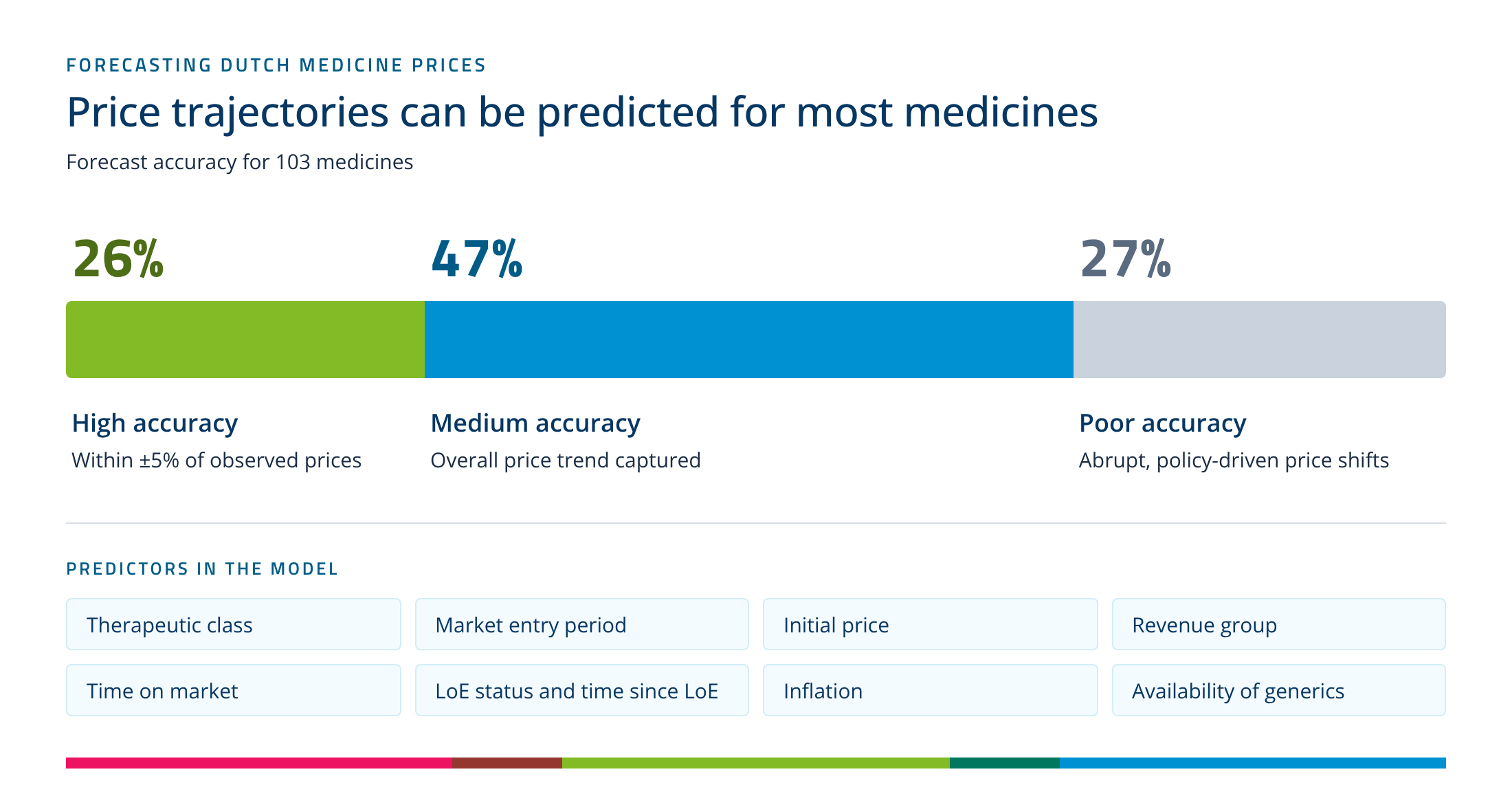 Accuracy of predicted medicine price trajectories against observed prices, and the predictors used in the model; internal validation on 103 held-out medicines, as published in J Mark Access Health Policy 2026;14:65.
The model was tested on medicines held out of the training set. For about a quarter of them, the forecasts closely matched observed prices. For nearly half, the forecasts captured the overall price trend. Accuracy was similar before and after LoE. The medicines the model predicted poorly were mostly affected by abrupt price shifts from policy changes, reimbursement decisions or price negotiations. Historical patterns could not anticipate these shifts.
Accounting for expected price erosion would generally lower ICERs and budget impact estimates. This would give HTA bodies and payers a more realistic view of the lifetime cost of investing in a new medicine.
It also raises a question the authors leave open. With static prices, all the value of post-LoE price reductions goes to payers and society. Recognising that value at market access moves part of it to earlier in the life cycle. Several issues need policy debate before dynamic prices enter reimbursement practice:
Two practical limitations remain. First, the ensemble is a black box, which conflicts with the transparency HTA requires. Explanation methods such as SHAP could help. Second, the model is calibrated to Dutch list prices, where reference pricing and generic competition make post-LoE price drops visible. Using it in other countries would need a separate assessment. Dynamic price forecasts should add to standard uncertainty and sensitivity analyses, not replace them.
This research was conducted by Simon van der Schans, Simon van der Pol, Laura Burgers, Mark H. Rozenbaum and Cornelis Boersma, published in the Journal of Market Access & Health Policy, Volume 14, 2026, and funded by Pfizer Nederland. Full conflict-of-interest disclosure is available in the published article.
References:
(1) van der Schans S, Vondeling GT, Cao Q, van der Pol S, Visser S, Postma MJ, Rozenbaum MH. The impact of patent expiry on drug prices: insights from the Dutch market. J Mark Access Health Policy. 2020;9:1849984.
(2) Schöttler MH, Coerts FB, Postma MJ, Boersma C, Rozenbaum MH. The Effect of the Drug Life Cycle Price on Cost-Effectiveness: Case Studies Using Real-World Pricing Data. Value Health. 2023;26:91–98.
(3) van der Schans S, van der Pol S, Burgers L, Rozenbaum MH, Boersma C. Dynamic Medicine Prices for Health-Economic Analyses in the Netherlands: A Case for Integrating Pre- and Post-Exclusivity Price Dynamics. J Mark Access Health Policy. 2026;14:65. https://doi.org/10.3390/jmahp14040065
(4) Farminform B.V. De Centrale Datatrust Voor Geneesmiddelen en Farmaceutische Zorg. 18 September 2024. Available online: https://www.farminform.nl/ (accessed on 7 October 2024). Florian Zeevat : 6 November 2025, 13:33:44 CET
Join Health-Ecore at ISPOR Europe 2025 in Glasgow to explore HEOR research on prevention, obesity, Alzheimer’s, and informal care.

 Tanja Fens : 10 October 2025, 15:28:23 CEST
Health-Ecore and the Pharma & Health Policy Hub have entered into a strategic partnership to advance research, provide expert advisory services, and...
 Tanja Fens : 4 November 2025, 13:48:45 CET
Health-Ecore and MedEngine are joining forces in a new collaboration to enhance market access and real-world evidence solutions across Europe. By...

 Ece Aydin : 7 May 2026, 14:09:40 CEST
The economic case for higher vaccination uptake in the Netherlands, what each percentage point gain is worth to society across measles, pertussis,...