2 min read

The Value of Efforts to Increase Vaccination Uptake in the Netherlands

The Value of Efforts to Increase Vaccination Uptake in the Netherlands

Vaccination prevents disease, reduces societal costs, and, when coverage is high enough, eliminates the threat of outbreaks entirely. Yet in the Netherlands, coverage rates are falling across the board. This pragmatic analysis estimates the societal return from investing in programmes that reverse that trend.  

A 2024 WHO analysis found that vaccination has saved at least 154 million lives over the past fifty years, making it one of the best investments in public health ever made (1). Yet, rates in the Netherlands are falling. Measles, mumps, rubella vaccination (MMR) coverage has fallen to 79% nationally, well below the 95% threshold needed for herd immunity. Maternal pertussis vaccination stands at 67%. Human papilloma virus vaccination (HPV) coverage in recent cohorts is around 56%. At these levels, the risk of outbreaks grows, and avoidable disease burden accumulates year on year.

Commissioned by the Ministry of Health, Welfare and Sport, Health-Ecore developed a set of disease-specific calculators to estimate the societal value of increasing vaccination uptake for measles (MMR), maternal pertussis (DTP), and HPV. The calculators take a pragmatic, evidence-based approach, designed to support the evaluation of municipal ‘neighbourhood-based’ vaccination programmes. Due to the scope of the analysis several assumptions had to be made. The analysis assumed linear relationships between coverage and disease burden, which means results should be read as indicative. The findings nonetheless offer a starting point for conversations about the economic case for these programmes.  

What the calculators show  

The analysis takes a societal perspective, including healthcare costs, productivity losses from missed work, and quality-of-life losses measured in QALYs (quality-adjusted life years). Two QALY thresholds were applied: €20,000 per QALY (recommended by the Health Council for vaccines) and €50,000 per QALY (applied by the Health Council for influenza vaccination advice).  


ebb353bf-400d-4ec8-bc9b-49a5a2b6639e


Measles

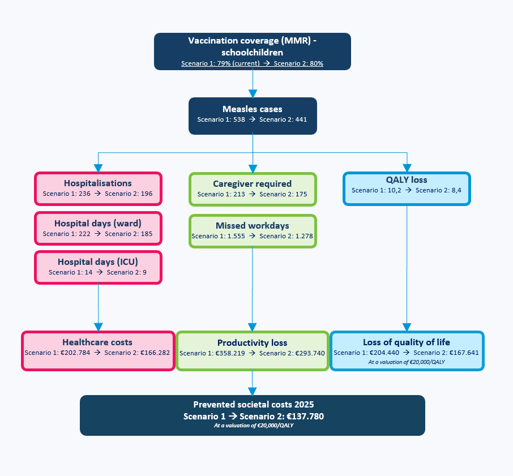
For measles, the Netherlands recorded 539 cases in 2025, with local clusters emerging in multiple cities. Based on evidence showing that a one percentage point increase in coverage reduces measles incidence by 18% (2), raising national MMR coverage from 79% to 80% would have reduced total societal costs by €137,780 in 2025. The 2013 outbreak, with 2,688 cases, carried a total estimated societal cost of €3.8 million.  


Maternal Pertussis Vaccination

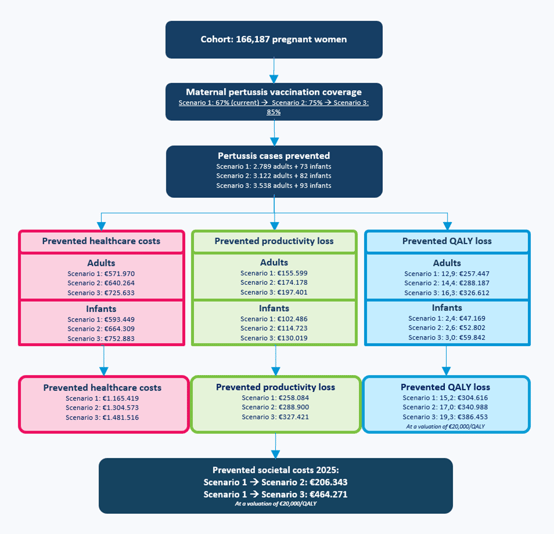
Newborns are most vulnerable to severe pertussis in the first weeks of life; before they can receive their own vaccines. Maternal DTP vaccination at 22 weeks of pregnancy provides direct protection from birth. Raising coverage from the current 67% to 75% would generate annual societal savings of €206,281. A more ambitious increase to 85% would produce cumulative savings of €464,214 compared to the current situation.  


Human Papilloma Virus

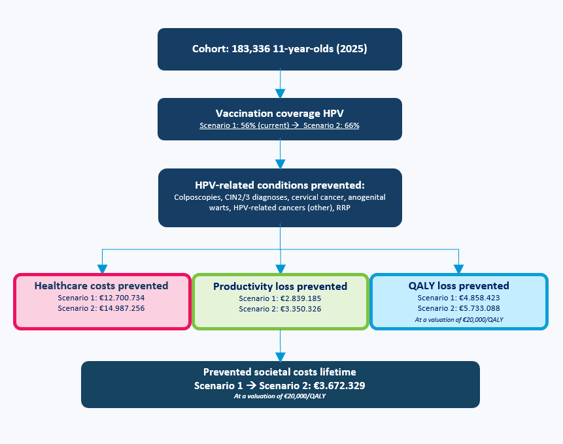
For HPV, the impact unfolds over a lifetime. Because the consequences of infection materialise years later, the calculator projects effects over the lifetime of a cohort of 11-year-olds. At the current 56% coverage, vaccination already prevents an estimated €12.7 million in healthcare costs and €2.8 million in productivity losses for the 2025 cohort over their lifetime. Increasing coverage by 10 percentage points to 66% would generate an additional €3.67 million in societal savings over the lifetime of this cohort. 


What these findings imply for investment in vaccination programmes

The calculators do not include the cost of the vaccines themselves; these are already funded through the National Immunisation Programme. What they quantify is the return from investing in supplementary programmes designed to raise uptake, e.g. neighbourhood outreach, targeted communication, accessible vaccination points, and trust-building with hesitant communities. In every scenario modelled, the societal savings from reaching the target coverage generate positive returns.

The results are indicative, as the calculators cannot capture the effects of e.g. cyclical outbreaks and herd effects. They do show that investments deliver substantial societal benefits, therefore, informing policymakers and strengthening the case for budget allocation towards future interventions. Additionally, this analysis allows for further research on this topic. A vaccinated population is a healthy and productive one, and the economic case for increasing vaccination uptake is clear.


(1) Global immunization efforts have saved at least 154 million lives over the past 50 years [Internet]. [cited 2026 Jan 20]. Available from: https://www.who.int/news/item/24-04-2024-global-immunization-efforts-have-saved-at-least-154-million-lives-over-the-past-50-years
(2) Leong WY, Wilder-Smith AB. Measles Resurgence in Europe: Migrants and Travellers are not the Main Drivers. J Epidemiol Glob Health. 2019;9(4):294–9.
RSV vaccination: a cost-effective strategy for older adults in the Netherlands

RSV vaccination: a cost-effective strategy for older adults in the Netherlands

Respiratory Syncytial Virus (RSV) is increasingly recognized as a serious health threat for older adults. In the Netherlands, RSV may lead to...
Read More
Launch of the vaccination guideline for adults with chronic lung disease

Launch of the vaccination guideline for adults with chronic lung disease

On World Lung Day, the Long Alliantie Nederland introduced the first national vaccination guideline for adults with chronic lung disease. Developed...

Read More
RSV immunization for children

RSV immunization for children

Read our newly published paper on an RSV immunization programme for the Netherlands.

Read More
What Delayed RSV Vaccination Is Costing the Netherlands

What Delayed RSV Vaccination Is Costing the Netherlands

Every winter, the Respiratory Syncytial Virus (RSV) fills hospital wards. Around 6,000 older adults are admitted with RSV infection in the...

Read More