Sharing Insights at ISPOR Europe 2025: Our Poster Highlights
 Florian Zeevat : 6 November 2025, 13:33:44 CET
Join Health-Ecore at ISPOR Europe 2025 in Glasgow to explore HEOR research on prevention, obesity, Alzheimer’s, and informal care.
2 min read

Estimates suggest that between 1.8 and 5 million informal caregivers are active in the Netherlands, ranging from individuals providing long‑term, intensive support to those offering occasional assistance. This broad range reflects differences between strict definition(1) and broad definition(2). Informal caregivers make an indispensable contribution to Dutch society—both through practical support and by easing the burden on the formal healthcare system.
Driven by population ageing and increasing life expectancy, the demand for informal care is expected to rise substantially in the coming decades. At the same time, policymakers are encouraging higher labour participation among older adults to address workforce shortages and reduce pressure on healthcare and pension systems. This creates a paradox: while society increasingly depends on informal care, it becomes more difficult for working individuals to combine caregiving responsibilities with employment.
What Our Microsimulation Model Reveals About the Future of Informal Care
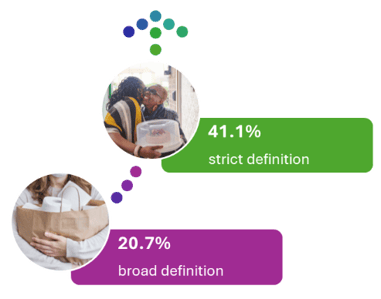
To shed light on these developments, we used our microsimulation model to project the number of informal caregivers and the total volume of informal care hours between 2025 and 2050. The model indicates that the number of informal caregivers will grow by 20.7% (broad definition) to 41.1% (strict definition), while total annual informal care hours are expected to increase from 1.35–1.63 billion hours in 2025 to 1.91–2.00 billion hours in 2050.
The Financial Weight of Informal Care in an Ageing Society
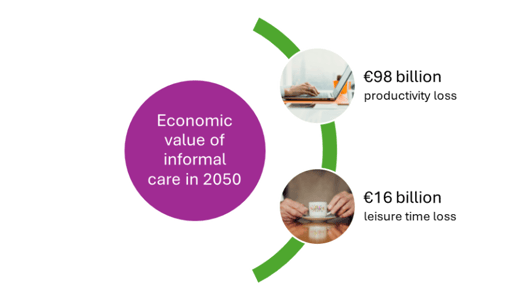
Alongside these volume projections, we conducted a monetary valuation of informal care. This valuation presents methodological challenges: should caregiving time be treated as a loss of productivity, or as a loss of leisure time? Depending on the chosen approach—ranging from the opportunity cost of leisure to valuation based on productivity losses—the estimated economic value of informal care in 2050 ranges from €16 billion to €98 billion per year.
Relevance in cost-effectiveness analyses
The economic value of informal care is also relevant for cost‑effectiveness analyses. When individuals become ill, they may no longer be able to provide informal care, while simultaneously requiring more support themselves. Our model captures these dynamics by estimating, for each age group, the average number of informal care hours provided and received.
With this initial modelling effort, we have taken an important step toward establishing a systematic and standardised approach to quantifying the societal value of informal care—both in terms of time invested and its broader economic significance.
(1) Elayan S, Angelini V, Buskens E, et al. The Economic Costs of Informal Care: Estimates from a National Cross-Sectional Survey in The Netherlands. Eur J Health Econ HEPAC Health Econ Prev Care. 2024 Nov;25(8):1311–31.
(2) Participatie | Verantwoording | Definities | Volksgezondheid en Zorg [Internet]. Available from: https://www.vzinfo.nl/participatie/verantwoording/definities#mantelzor
 Florian Zeevat : 6 November 2025, 13:33:44 CET
Join Health-Ecore at ISPOR Europe 2025 in Glasgow to explore HEOR research on prevention, obesity, Alzheimer’s, and informal care.

 Simon van der Schans : 18 September 2025, 14:57:30 CEST
Discover the societal impact of Alzheimer’s in the Netherlands and how new treatments can reduce care needs and costs while improving patient...

 Simon van der Pol : 21 May 2025, 00:00:00 CEST
Discover how nirsevimab offers cost-effective RSV prevention for Dutch infants, supporting universal immunization and reducing healthcare costs.

Adjuvanted influenza vaccines for older adults in the Netherlands are a cost-effective strategy, reducing hospitalizations and healthcare costs...