

2 min read

Adjuvanted influenza vaccine is a cost-effective investment for older adults in the Netherlands

Adjuvanted influenza vaccine is a cost-effective investment for older adults in the Netherlands

Replacing standard-dose with adjuvanted influenza vaccination in adults aged 60 and over, and in high-risk adults aged 50–59, could prevent hundreds of hospitalisations and deaths per season, at an incremental cost well within accepted Dutch thresholds. 

By Susan de Braak, Joaquin F. Mould-Quevedo, Jan C. Wilschut, Gerrit A. van Essen, Albert Osterhaus, Maarten J. Postma & Florian Zeevat,  Published in Human Vaccines & Immunotherapeutics , Volume 22, 2026. 


A gap in the Dutch evidence base

Influenza remains a substantial burden on Dutch healthcare every winter. In the 2022/2023 season alone, around 837,000 individuals in the Netherlands experienced symptomatic influenza, approximately 169,000 consulted a general practitioner, and more than 7,000 were hospitalised. For older adults and those with underlying conditions, the consequences frequently extend beyond the acute episode , influenza can trigger functional decline, increased frailty, and a greater need for rehabilitation or long-term care.

The Dutch National Immunisation Programme currently offers standard-dose influenza vaccination to adults aged 60 and over, as well as high-risk individuals. Enhanced vaccines, including adjuvanted influenza vaccine (aIV), which boosts immune response, have consistently outperformed standard formulations in older populations. In December 2024, the Dutch Health Council concluded that enhanced vaccines could be introduced into the programme, however, evidence of cost-effectiveness is required.

Despite this recommendation, and despite cost-effectiveness analyses having been conducted in several other European countries, no such analysis had been performed specifically for the Netherlands. We set out to fill that gap.


Key findings: replacing standard-dose influenza vaccines by adjuvanted influenza vaccines in the Netherlands is likely to be a cost-effective strategy  

Using a validated static decision-tree model adapted to the Dutch setting, we simulated an average influenza season over the 2013–2020 period and compared two strategies: vaccination with standard-dose vaccines (sIV) or switching to adjuvanted vaccination (aIV). The analysis was conducted from a societal perspective, capturing both direct healthcare costs and indirect costs including productivity losses.

The relative vaccine effectiveness (rVE) of aIV over sIV was modelled across the 10–30% range assessed by the Dutch Health Council, based on real-world evidence from studies enrolling over 10,000 individuals each. This range reflects the heterogeneity of the available evidence on relative vaccines effectiveness, which was also tested across a wider range in scenario analyses.

 hec_infographic_aiv_debraak2026

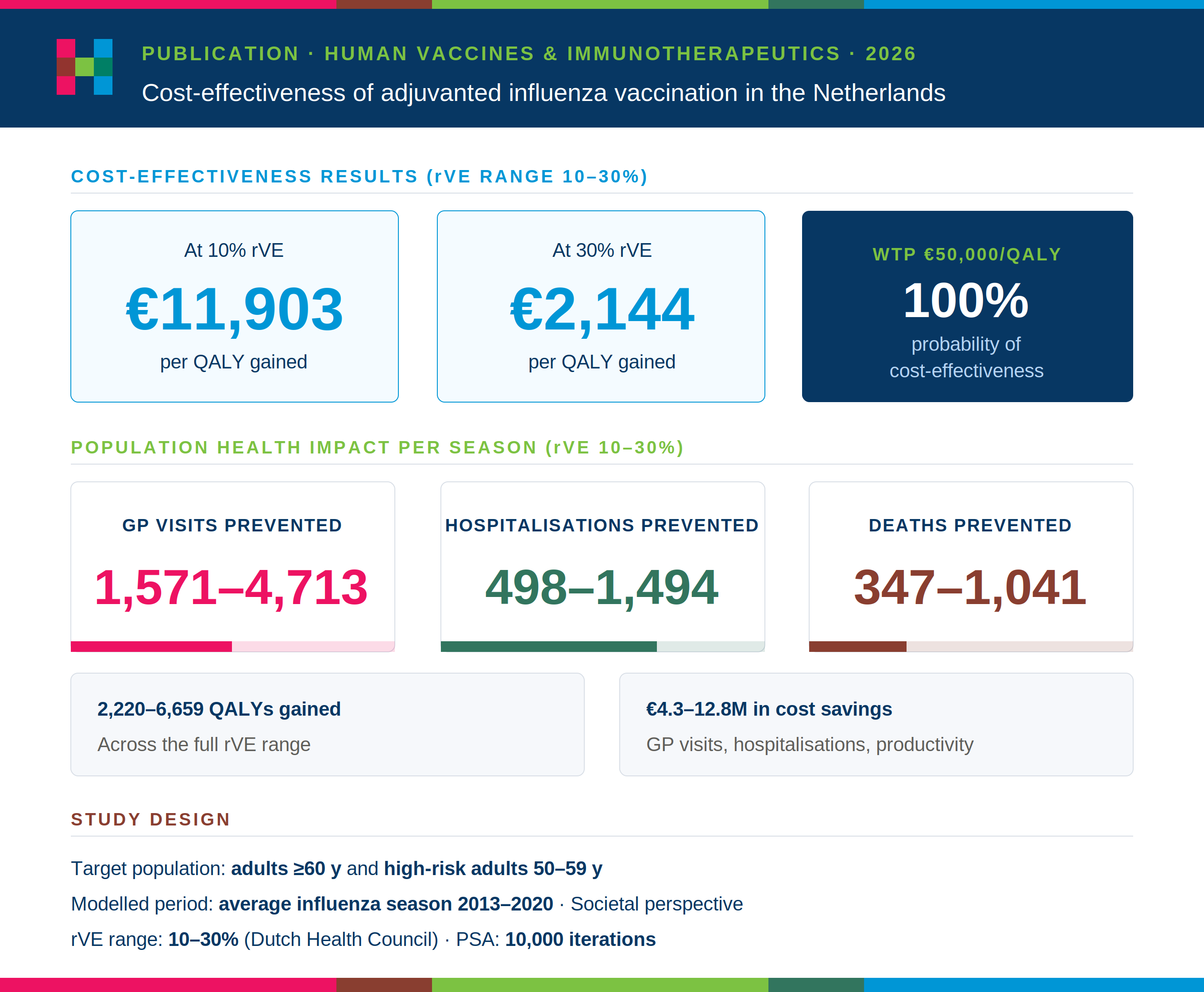
The results are clear across the full evidence range. At an rVE of 10%, we found an ICER of €11,903 per QALY gained; at an rVE of 30%, the ICER fell to €2,144 per QALY, both well below the Dutch willingness-to-pay threshold of €50,000 per QALY. The probabilistic sensitivity analysis, based on 10,000 Monte Carlo simulations, confirmed a 100% probability of cost-effectiveness at that threshold for both bounds of the rVE range. Even at the more conservative €20,000/QALY threshold, the probability remained at or very close to 100%. Cost-effectiveness holds: even at an rVE as low as 2.5%, well below the assessed range, the ICER of €55,817 only marginally exceeds the commonly cited threshold.

In one average season, switching to aIV would prevent between 1,571 and 4,713 GP visits, 498 to 1,494 hospitalisations, and 347 to 1,041 deaths, translating into €4.3 to €12.8 million in direct cost savings and 2,220 to 6,659 QALYs gained.


From evidence to policy 

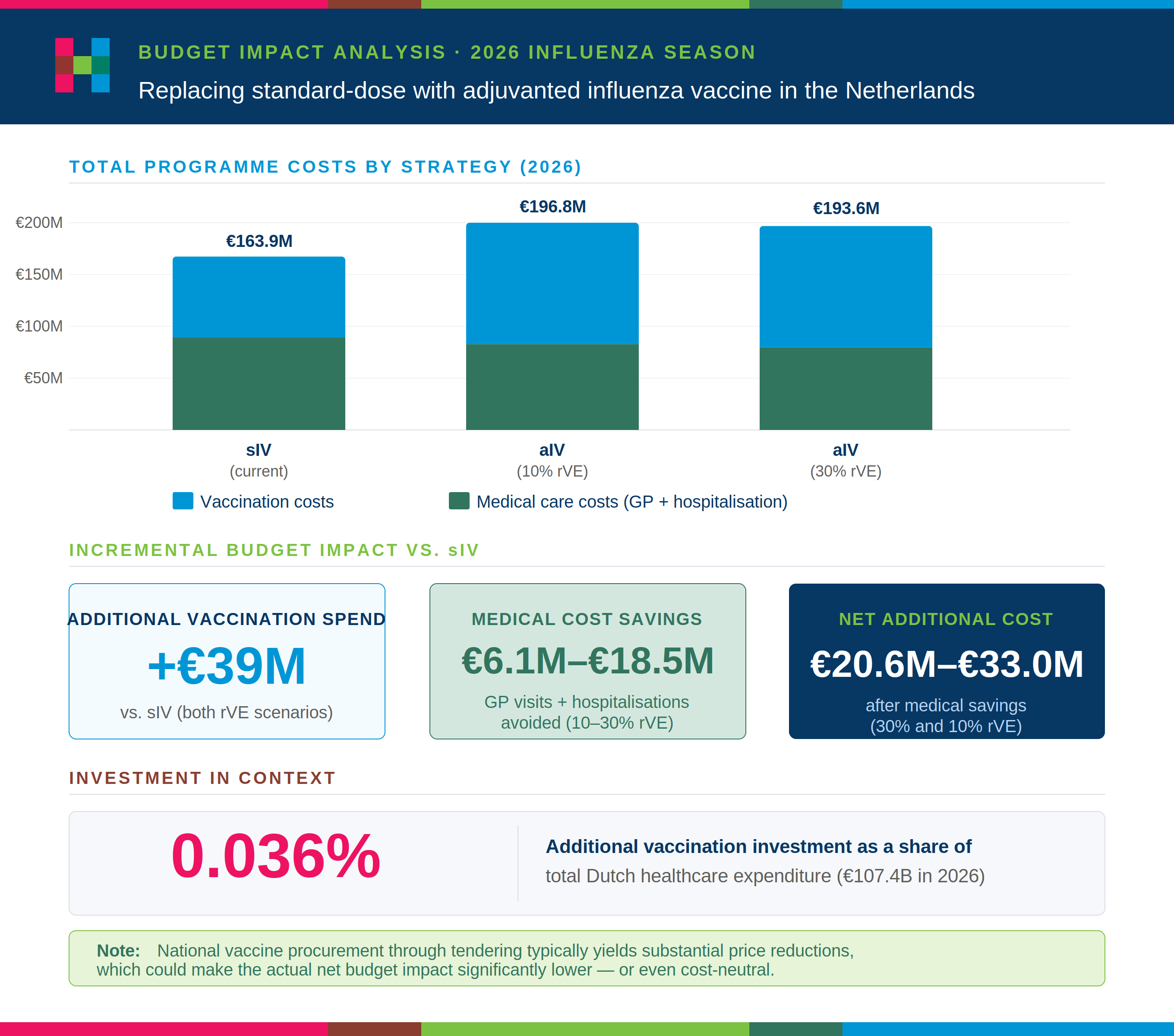
The upfront investment in switching to aIV is modest relative to the national healthcare budget, and substantially offset by avoided GP consultations and hospitalisations, as the figures show. National procurement through tendering could reduce the net cost further still.

hec_infographic_aiv_bia_debraak2026

A direct economic comparison between aIV and high-dose influenza vaccine (HD-IV) is not yet possible given data heterogeneity, but both have now been assessed as cost-effective in the Dutch context, together providing the evidence for enhanced vaccines, the Health Council's 2024 recommendation called for.


This research was funded by CSL Seqirus. Full conflict-of-interest disclosures are available in the published article. 

High-dose influenza vaccination remains a cost-effective investment for older adults in the Netherlands

High-dose influenza vaccination remains a cost-effective investment for older adults in the Netherlands

Updated health-economic evidence, drawing on data from more than 85 million individuals, confirms that switching from standard-dose to high-dose...

Read More
RSV vaccination: a cost-effective strategy for older adults in the Netherlands

RSV vaccination: a cost-effective strategy for older adults in the Netherlands

Respiratory Syncytial Virus (RSV) is increasingly recognized as a serious health threat for older adults. In the Netherlands, RSV may lead to...

Read More
Launch of the vaccination guideline for adults with chronic lung disease

Launch of the vaccination guideline for adults with chronic lung disease

On World Lung Day, the Long Alliantie Nederland introduced the first national vaccination guideline for adults with chronic lung disease. Developed...

Read More
RSV immunization for children

RSV immunization for children

Read our newly published paper on an RSV immunization programme for the Netherlands.

Read More