 Simon van der Pol

A new cost-effectiveness analysis finds that the next-generation vaccine mRNA-1283 could prevent thousands more hospitalisations and deaths than the vaccine currently used in the Netherlands, at a price the Dutch healthcare system can justify.
COVID-19 remains a substantial burden, even in the post-pandemic era
COVID-19 no longer dominates the headlines, but it hasn't gone away. Each year it continues to circulate alongside influenza and RSV, often peaking in the same winter months, which keeps sustained pressure on primary and secondary care. Older adults and people with underlying medical conditions remain those most at risk of severe disease.
Without vaccination, a new publication (1) estimates that adults aged 60 and over and high-risk adults aged 18–59 in the Netherlands would face 460,000 symptomatic COVID-19 infections, 24,000 hospitalisations, and 5,300 deaths in a single season. The Dutch Health Council has progressively narrowed its COVID-19 vaccination recommendation in recent years, reflecting a declining but still meaningful disease burden, while vaccination coverage has fallen alongside it, from around 47% in 2024 to 42% in 2025.
A next-generation vaccine with measurable added value
A next-generation COVID-19 vaccine, mRNA-1283 (mNEXSPIKE®), was recently approved in the European Union (2). It delivers a fifth of the mRNA dose of the original mRNA-1273 vaccine, but its design was intended to sharpen the immune response. In the pivotal phase 3 NextCOVE trial (3), it showed higher efficacy than mRNA-1273, with the largest differences observed in adults 65 and older and those with underlying conditions. It's worth noting that mRNA-1273 itself is not currently part of the Dutch national programme; the comparison in the new study (1) serves as a clinical benchmark, not a choice between two vaccines actually on offer.
Previously published Dutch cost-effectiveness model (4) was adapted to estimate what mRNA-1283 could mean for public health and healthcare spending, comparing it against no vaccination as well as against mRNA-1273 and BNT162b2, the vaccine currently used in the Netherlands.
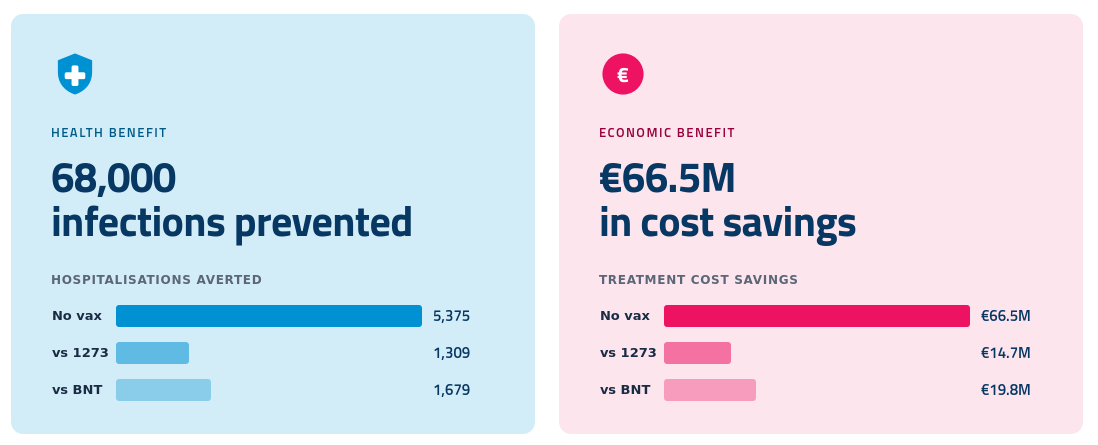 RNA-1283: health and economic value for the Dutch COVID-19 program; Base-case results, per person as published at Vaccines 2026;14:364
Vaccinating with mRNA-1283 was estimated to prevent 68,000 infections, 5,400 hospitalisations, and 1,200 deaths compared with no vaccination, saving over €66.5 million in treatment costs and gaining 9,667 QALYs. At the Dutch willingness-to-pay threshold of €50,000 per QALY, this puts the economically justifiable price at €238 per dose.
Against mRNA-1273, mRNA-1283 was estimated to prevent an additional 1,309 hospitalisations and 295 deaths, remaining cost-effective at an incremental price of up to €62 per dose. Against BNT162b2, the vaccine actually in use in the Dutch programme, the added benefit was larger still: 1,679 hospitalisations and 378 deaths averted, cost-effective at an incremental price of up to €80 per dose. These results held up across a wide range of sensitivity and scenario analyses, including higher and lower COVID-19 incidence assumptions.
From evidence to policy
Vaccine prices in the Netherlands are confidential, negotiated through European tenders, so the economically justifiable price presented in the new publication (1) should be read as a benchmark rather than an actual negotiated figure. mRNA-1283's real-world effectiveness has not yet been established outside clinical trials, and the static model used here doesn't capture indirect protection from reduced transmission, a factor that, in related analyses, has tended to make cost-effectiveness estimates more conservative rather than less. Post-COVID-19 condition was left out of the base case given the uncertainty around its current incidence, though a scenario analysis including it suggests the case for the vaccine would only get stronger.
Taken together, the findings support continued investment in COVID-19 vaccination as a public health measure. Next-generation vaccines such as mRNA-1283 may offer a way to further optimise the existing programme for those most vulnerable to severe disease.
This research was conducted by Simon van der Pol, Ekkehard Beck, Tjalke Westra, Maarten Postma and Cornelis Boersma, published in Vaccines, Volume 14, 2026, and funded by Moderna, Inc. Full conflict-of-interest disclosure is available in the published article.
References:
(1) van der Pol S, Beck E, Westra T, Postma M, Boersma C. Potential Public Health and Economic Impact of the Next-Generation COVID-19 Vaccine mRNA-1283 in The Netherlands. Vaccines. 2026; 14(4):364. https://doi.org/10.3390/vaccines14040364
(2)European Medicines Agency (EMA). mNexspike. Available online: mNexspike | European Medicines Agency (EMA)
(3) Chalkias S, Dennis P, Petersen D, et al. Efficacy, immunogenicity, and safety of a next-generation mRNA-1283 COVID-19 vaccine compared with the mRNA-1273 vaccine (NextCOVE): results from a phase 3, randomised, observer-blind, active-controlled trial. Lancet Infect Dis. 2025;25(11):1230-1242. doi:10.1016/S1473-3099(25)00236-1
(4) Zeevat F, van der Pol S, Westra T, Beck E, Postma MJ, Boersma C. Cost-effectiveness Analysis of COVID-19 mRNA XBB.1.5 Fall 2023 Vaccination in the Netherlands. Adv Ther. 2025;42(3):1550-1569. doi:10.1007/s12325-025-03112-y